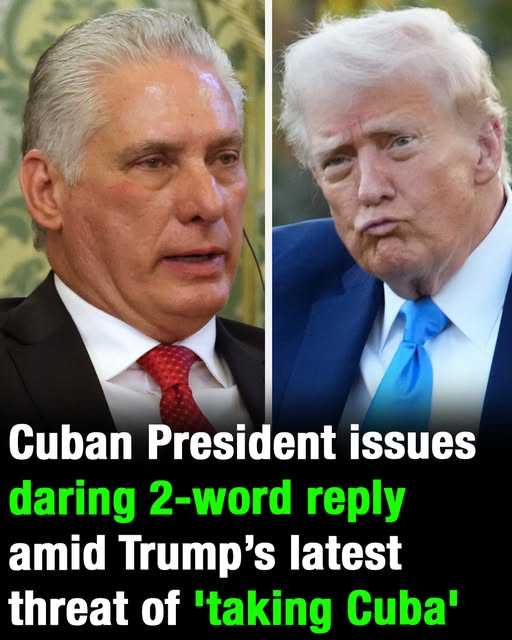
Escalation in the Caribbean: Trump Eyes Cuba as Next Objective Following Iran Conflict
WASHINGTON D.C. / HAVANA — The geopolitical landscape is shifting at a breakneck pace as President Donald Trump, currently in the throes of a second term defined by aggressive interventionism, has turned his sights toward Havana. In a series of provocative statements that have set the diplomatic world on edge, the U.S. President suggested that the American military may “stop by” Cuba once current operations in Iran reach their conclusion.
The rhetoric marks a significant escalation in what has already been a transformative and volatile period for U.S. foreign policy. Since returning to the Oval Office, Trump has maintained a relentless offensive posture: from the capture of Nicolás Maduro in Venezuela to threats of seizing Greenland by force, and the ongoing high-stakes conflict in Iran. Now, the “Island of Freedom” appears to be back in the crosshairs.
“I Could Do Anything I Want With It”
The tension began simmering in mid-March when the President first hinted at a looming shift in policy. “We’ll be doing something with Cuba very soon,” Trump told reporters, later doubling down with a claim of absolute authority over the island’s fate.
“Whether I free it, take it, I think I could do anything I want with it,” Trump stated, asserting a bold vision for U.S. hegemony in the region.
On Monday, speaking from the White House, the President reinforced this trajectory. Characterizing Cuba as a “failing nation” that has been “horribly run for many years,” Trump explicitly linked the island to the conclusion of the war in Iran. He framed the potential intervention as a debt owed to his domestic constituency.
“We have a lot of great Cuban Americans, all of whom just about voted for me, and they were treated very badly,” Trump said. “In many cases, family members have been killed. They’ve been beaten up and mugged and terrible things happened in Cuba.”
Havana Vows “Impregnable Resistance”
The response from the revolutionary government has been one of defiance rather than retreat. Facing heavy U.S. sanctions and a crippling domestic energy crisis that has plunged much of the nation into daily blackouts, President Miguel Díaz-Canel has made it clear that Cuba will not yield.
In an initial response via X (formerly Twitter), Díaz-Canel warned that any attempt to dismantle the Cuban government would be met with “an impregnable resistance.” This sentiment was amplified during a recent appearance on NBC News’ Meet the Press. Speaking through a translator, the Cuban leader challenged the lack of “justification” for an American assault.
“If [an attack] happens, there’ll be fighting and there’ll be a struggle and we’ll defend ourselves,” Díaz-Canel said. “And if we need to die, we’ll die. As our national anthem says, ‘dying for the homeland is to live.’”
Closing the interview with a personal vow of martyrdom, he added: “I have no fear. I am willing to give my life for the revolution.”
A Nation on the Brink
The war of words comes at a moment of extreme vulnerability for the Cuban people. The Trump administration’s tightened sanctions—which Díaz-Canel has labeled “genocidal and cruel”—have exacerbated a failing power grid and a stagnant economy. While Washington views these pressures as a necessary means to “free” the island, Havana views them as a deliberate attempt to starve the population into submission.
As the U.S. military remains occupied in the Middle East, the world now watches the Florida Straits to see if the President’s “stop by” becomes a reality, or if the diplomatic standoff will reach a breaking point.
What is your take on the current administration’s stance? Should the U.S. leave Cuba to determine its own path, or is it time for direct action? Share your thoughts in the comments below.