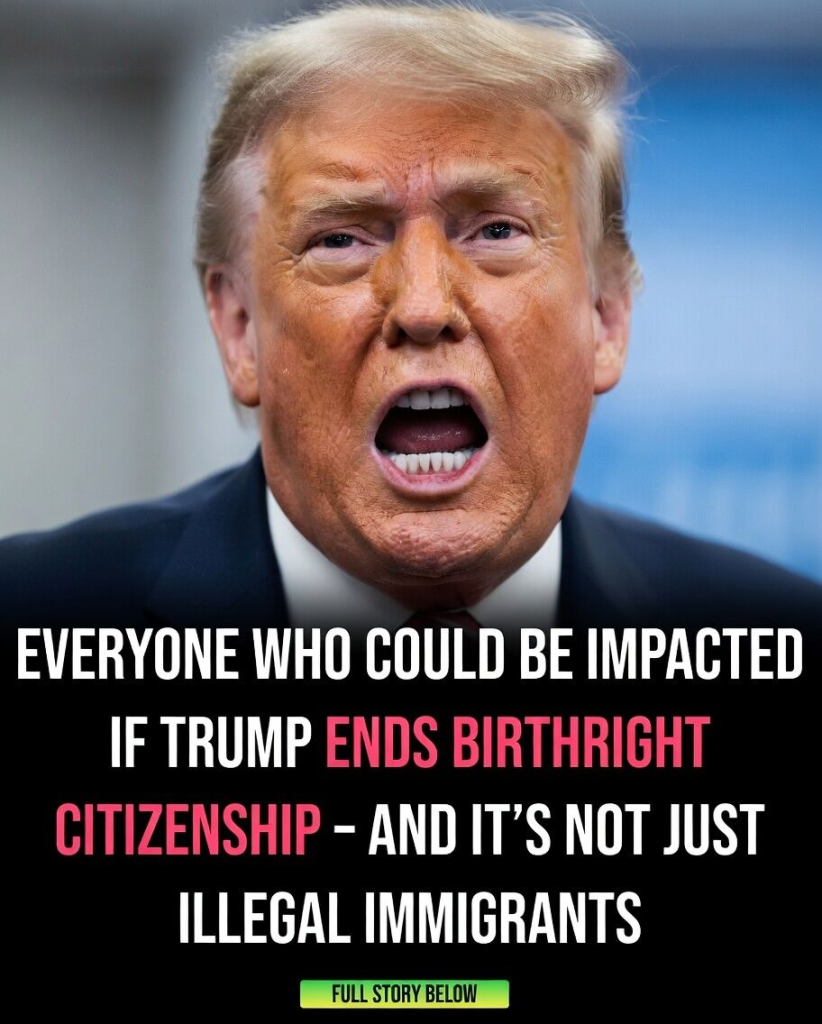
The debate over birthright citizenship in the United States has once again taken center stage, following renewed efforts by Donald Trump to challenge a policy that has been in place for more than a century. While much of the public conversation has focused on undocumented immigrants, the reality is far more complex. The potential consequences of ending birthright citizenship would extend well beyond a single group, touching millions of lives and raising fundamental questions about identity, belonging, and the interpretation of the 14th Amendment.
At the heart of this issue is a constitutional principle that has defined American citizenship since 1868. The 14th Amendment clearly states that anyone born on U.S. soil is automatically a citizen, regardless of their parents’ status. This guarantee was originally established in the aftermath of the American Civil War to ensure that formerly enslaved individuals and their descendants would be recognized as full citizens. Over time, it has become one of the most foundational aspects of American law, shaping how the country defines itself as a nation of immigrants.
If birthright citizenship were to be restricted or eliminated, one of the most directly affected groups would be children born to undocumented immigrants. For decades, these children have been recognized as U.S. citizens at birth, granting them access to rights such as education, healthcare, and legal protections. Removing that automatic status would create a new category of individuals born in the country but not recognized as citizens, potentially leaving them in a state of legal uncertainty. This could have long-term consequences, not only for those individuals but also for communities and institutions that rely on clear definitions of citizenship.
However, the impact would not stop there. One of the most significant—and often overlooked—groups affected would be children born to parents who are legally in the United States on temporary visas. This includes professionals on work visas, international students, researchers, and even tourists. Under the proposed changes, their children could also be denied automatic citizenship, despite their parents following all legal requirements to be in the country. This shift could alter how the United States is perceived globally, particularly among highly skilled workers who may reconsider relocating if their children’s legal status is uncertain.
Another major consequence would be the potential rise of stateless individuals—people who are not recognized as citizens by any country. In cases where a child is born in the U.S. but does not automatically inherit citizenship from their parents’ home country, they could be left without any nationality at all. Statelessness can limit access to basic rights, including education, healthcare, and legal employment, creating a range of humanitarian and legal challenges. This issue has been a concern in other parts of the world, and critics argue that changing U.S. policy could introduce similar complications domestically.
The proposal has also sparked significant legal opposition. Multiple states have challenged the idea, arguing that altering birthright citizenship would require a constitutional amendment rather than an executive action. Figures like William Tong have been particularly vocal, emphasizing that the language of the 14th Amendment is clear and has been consistently upheld by courts. The matter has now reached the Supreme Court of the United States, where justices are being asked to consider whether such a fundamental shift can be implemented without rewriting the Constitution itself.
Beyond the legal arguments, there are broader social and economic implications to consider. Citizenship status affects access to education, employment opportunities, and social services. If large numbers of people born in the U.S. were no longer granted citizenship automatically, it could create new barriers and inequalities. Schools, healthcare systems, and local governments might face increased challenges in determining eligibility for services, while families could experience added stress and uncertainty about their future in the country.
Ultimately, the debate over birthright citizenship is about more than policy—it is about how a nation defines who belongs. For supporters of the current system, the principle is simple: being born in the United States makes you American, regardless of your background. For those advocating change, the argument centers on redefining that principle in a modern context. As discussions continue and legal battles unfold, the outcome could reshape not only immigration policy but also the very meaning of citizenship in the United States for generations to come.