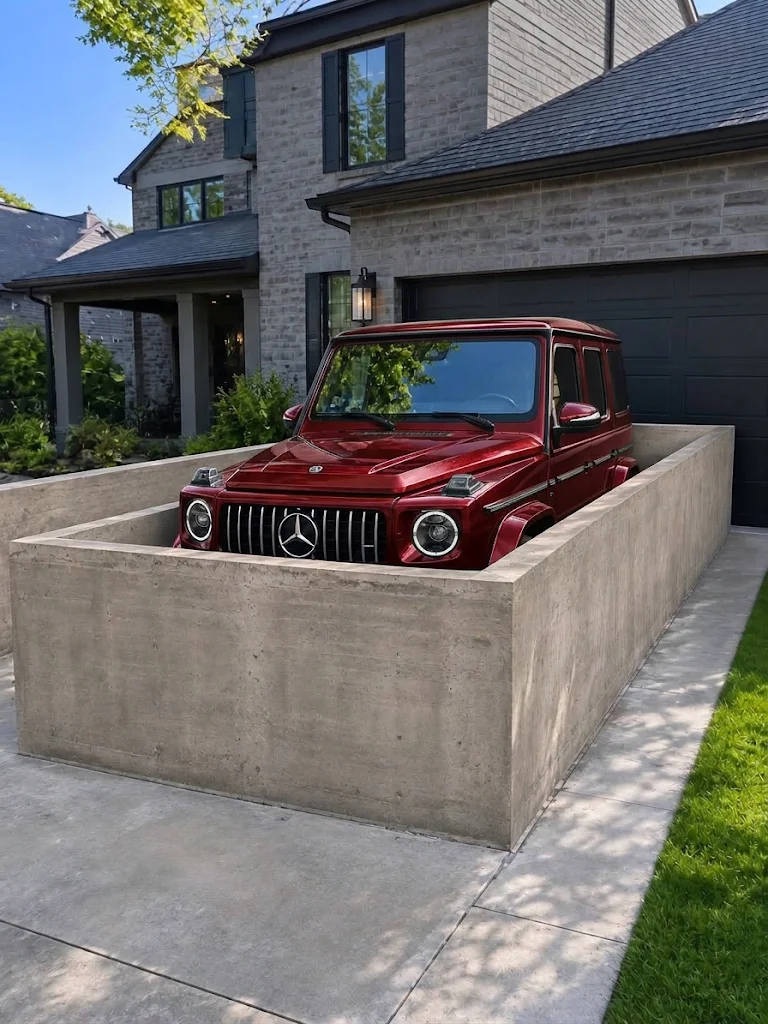
My name is Robert, and I’m forty-eight years old. For twenty-two years, I’ve worked as a groundskeeper at Pine Ridge Golf Club. After my divorce, maintaining my lawn became my greatest comfort. Every blade of grass represented patience and pride. Then Richard Vance moved next door, bringing three luxury cars and an attitude that immediately tested my patience.
Richard repeatedly parked his silver Mercedes directly on my lawn, crushing the grass and leaving deep tire marks. I politely asked him to stop twenty-three times. I left notes, contacted the police, and investigated towing options. Nothing worked. Richard simply laughed and said, “It’s just grass, old man.” After six months of humiliation, I decided to teach him a lesson.
My friend Fletcher worked in construction and had access to enormous concrete highway barriers. When I explained Richard’s behavior, he initially suggested installing a fence. But I wanted something Richard couldn’t ignore. One Saturday evening, we borrowed six heavy barriers and carefully positioned them around his Mercedes, which was once again parked on my property. We left approximately two feet of clearance on every side, creating a concrete enclosure around his expensive vehicle.
The following morning, I sat on my porch with iced tea, waiting for Richard to discover my surprise. His reaction was spectacular. He shouted, threatened lawsuits, and demanded that I remove the barriers immediately. I calmly reminded him that the car was parked on my property without permission. Richard called the police, certain they would force me to surrender.
When the officers arrived, they examined the situation and explained that the dispute required further civil consideration. They found no immediate grounds to arrest me, although they warned that the barriers could create liability issues. Richard was furious. Instead of negotiating, he hired a specialized crane operator named Orson to lift his Mercedes over the concrete enclosure. I watched the preparations with satisfaction, believing my stubborn neighbor was finally learning a lesson.
Orson arrived with a powerful crane and carefully inspected the Mercedes, the barriers, and the surrounding space. He immediately warned Richard that lifting a luxury vehicle from such a confined area would be dangerous. The car could swing unexpectedly, especially with my porch standing nearby. Richard dismissed his concerns and demanded that the operation continue. I remained seated with my iced tea, enjoying the thought of watching him spend a fortune correcting his own mistake.
The crane slowly lifted the Mercedes, and for several seconds everything appeared controlled. Then the vehicle began swinging sideways. Orson shouted instructions, but the heavy car moved toward my house. Before anyone could stop it, the Mercedes struck my porch with a terrible crash. Wooden railings shattered, and the main support post cracked beneath the impact. My satisfaction vanished instantly. What had started as revenge had become a dangerous disaster.
I rushed toward the porch, staring at the damaged support beam. Richard stood beside his wrecked Mercedes, speechless for the first time since moving next door. Orson immediately stopped the operation and secured the equipment. Nobody had been injured, but the damage was serious enough to require professional inspection.
Contractors examined my porch and estimated repairs would exceed fourteen thousand dollars. Insurance companies began investigating responsibility, and the situation quickly became complicated. Richard blamed the concrete barriers, while I argued that he had ignored repeated warnings about parking on my property.
Fletcher eventually pulled me aside and asked a question I didn’t want to answer. Had I installed the barriers to protect my lawn or humiliate Richard? I admitted that humiliation had been my real motivation. Suddenly, the victory I had imagined seemed foolish. My lawn was still damaged, and now my home needed expensive repairs.
Several days later, Richard approached me while I was examining the broken porch railing. I expected another argument or a threat from his lawyer. Instead, he stood quietly beside the steps and apologized. He admitted that repeatedly parking on my lawn had been disrespectful and unnecessary. For the first time, he seemed genuinely embarrassed by his behavior.
Richard explained that his stubbornness had already destroyed an important friendship. Twelve years earlier, he had argued with a longtime friend over a similar parking disagreement. Neither man had been willing to apologize, and their friendship had ended. Richard admitted that he had spent years convincing himself that the other person was responsible.
His confession surprised me. I had always viewed Richard as an arrogant millionaire who believed money could solve every problem. Hearing him acknowledge his mistakes made me reconsider my assumptions. I admitted that surrounding his Mercedes with concrete barriers had been an extreme response. I wanted to embarrass him, and my decision had created additional risks.
We spent the afternoon discussing practical solutions instead of assigning blame. Richard offered to pay for restoring my damaged lawn, while we agreed to address the remaining expenses through insurance and negotiation. It wasn’t an instant friendship, but it was the first honest conversation we had ever shared. Neither of us shouted, threatened, or demanded victory. We simply wanted the damage repaired.
Over the following weeks, contractors rebuilt my porch while a landscaping company restored the damaged sections of my lawn. The concrete barriers were professionally removed, and Richard’s Mercedes was taken away for assessment. Insurance representatives continued reviewing the claims, but Richard and I cooperated instead of making their work more difficult. He paid for the lawn restoration, and we reached an agreement concerning other expenses while the insurers addressed the remaining costs. Watching workers repair my porch reminded me how quickly anger could turn a manageable disagreement into an expensive disaster. I had been right to demand respect for my property, but my method of enforcing that demand had been reckless.
Richard began stopping by occasionally to ask about the repairs. Our conversations gradually became more comfortable. One afternoon, he mentioned that he had finally contacted the friend he had lost twelve years earlier. He had apologized without expecting forgiveness, and they had agreed to meet for coffee. Hearing that made me unexpectedly happy. Our argument had caused significant damage, but perhaps something useful had emerged from it. I realized that admitting mistakes did not make a person weak. Sometimes, it was the only way to repair what pride had destroyed.
Months later, my lawn was green again. The damaged patches had disappeared beneath healthy grass, and the rebuilt porch looked better than before. I returned to my familiar evening routine, sitting outside with iced tea after work. But something had changed. I no longer watched Richard’s driveway with suspicion, waiting for another confrontation. The tension between our houses had finally disappeared.
Richard occasionally joined me on the porch. We talked about work, family, and the strange ways people allow pride to control their decisions. He told me that reconnecting with his old friend had been one of the best things he had done in years. Their friendship wasn’t exactly the same, but they were rebuilding it. I understood that feeling better than he probably realized.
Looking back, I could see how easily the entire situation had escalated. Richard had repeatedly disrespected my property, and I had every reason to be upset. But surrounding his Mercedes with concrete barriers hadn’t solved the original problem. It had created a dangerous situation that damaged my home and cost thousands of dollars. My desire to win had nearly blinded me to the consequences.
Now, whenever I mow my lawn, I remember the lesson that experience taught me. Respect matters, and boundaries deserve protection, but revenge can become more destructive than the offense that inspired it. Richard learned that money and arrogance couldn’t excuse treating people badly. I learned that being right didn’t make every response reasonable. Sometimes, the smartest victory is choosing peace before pride turns a small disagreement into a disaster.