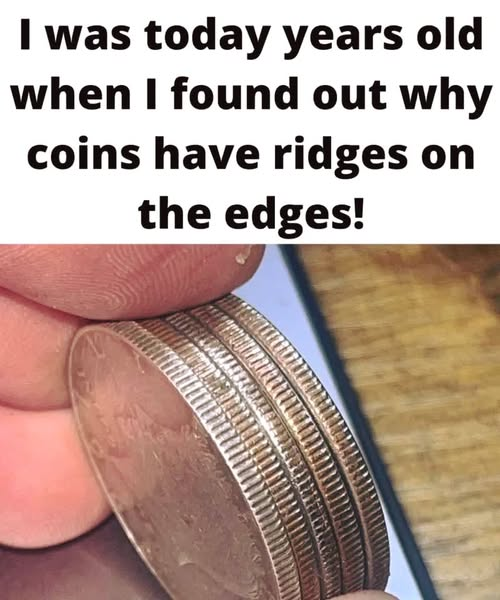
Coins are such a common part of everyday life that most people rarely stop to examine them closely. They pass through our hands at checkout counters, vending machines, parking meters, and coffee shops so frequently that their small design details fade into the background. Among those details, the ridged or grooved edges found on many coins are often overlooked entirely, even though they carry a surprisingly rich historical and functional purpose rooted in centuries of economic development.
Long before modern banking systems existed, coins were made from precious metals such as silver and gold. Their value was directly tied to the material they contained, not just the number stamped on their surface. Because of this, coins themselves held intrinsic worth, meaning that even small physical changes to them could result in financial gain for dishonest individuals. This created an environment where currency was vulnerable in ways that modern digital systems are not.
One of the most widespread forms of fraud in early coin-based economies was known as coin clipping. This involved shaving or scraping small amounts of metal from the edges of coins. While each individual coin only lost a tiny fraction of its material, criminals could collect these shavings over time and melt them down into a significant amount of precious metal. The altered coins, however, often still appeared normal enough to be spent at full value, allowing the fraud to go unnoticed in everyday transactions.
The long-term effects of this practice were serious. As more coins were clipped, the overall trust in currency began to decline. Merchants became suspicious of the coins they received, unsure whether they contained their full value. Governments also suffered losses in precious metal reserves, and entire economies faced instability as the integrity of their money supply was undermined. In some regions, this issue became so widespread that it contributed to broader financial reforms.
A major turning point in addressing this problem came during the late 17th century, when Isaac Newton played an unexpected but important role in financial history. In 1696, Newton was appointed Warden of the Royal Mint in England. Although he is best known for his contributions to physics and mathematics, he took his responsibilities at the Mint very seriously and became actively involved in combating counterfeiting and currency fraud.
One of the key innovations developed during this period was the introduction of reeded edges on coins. These evenly spaced grooves along the edges were designed as a practical security feature. The purpose was not decorative but functional: to make it immediately obvious if a coin had been tampered with. If someone attempted to shave or clip the metal, the pattern of ridges would be visibly disrupted, revealing the fraud.
This simple design change proved highly effective. Coins with consistent, uniform edges were much harder to alter without detection. At the same time, counterfeiters found it extremely difficult to replicate the precise spacing and uniformity of the grooves using the tools available at the time. As a result, the introduction of reeded edges helped restore confidence in the monetary system and significantly reduced the success of coin clipping.
Even though modern coins are no longer made from valuable precious metals like silver or gold, the ridged edges have remained a standard feature on many denominations. The reason for this is partly historical, but also practical. Modern currency systems still benefit from edge patterns as a security measure. Coin-operated machines, vending systems, and automated validators can use edge characteristics as part of their detection process to help identify counterfeit or damaged coins.
In addition to security, the ridges serve another important function. They help people who are visually impaired distinguish between different types of coins through touch alone. Since each denomination often has a unique size and edge texture, it becomes easier to identify coins without needing to see them clearly. This accessibility feature has become an important part of inclusive design in currency systems.
Tradition also plays a role in why ridged edges have persisted for so long. Over time, they have become a familiar and expected part of coin design. People associate certain textures and appearances with specific values, and changing that design too drastically could create confusion. As a result, many modern currencies preserve these historical features even when the original economic reasons are no longer relevant.
Interestingly, not all coins have ridged edges. Lower-value coins such as pennies or nickels in some systems are often left smooth. Historically, this is because their metal content was not valuable enough to justify the risk or effort of clipping. In contrast, higher-value coins like dimes and quarters were more likely to be targeted, which is why they retained the protective grooved design.
Today, those small ridges are easy to ignore, but they represent a long history of innovation in financial security. They are a reminder that even the smallest design choices in everyday objects can have deep historical roots and practical purposes. What appears to be a minor detail in modern currency is actually a surviving solution to a centuries-old problem involving trust, fraud, and economic stability.
In that sense, every coin carries more than just monetary value. It carries a trace of history—evidence of how societies adapted to protect their systems of exchange and maintain confidence in something as simple, yet essential, as money.