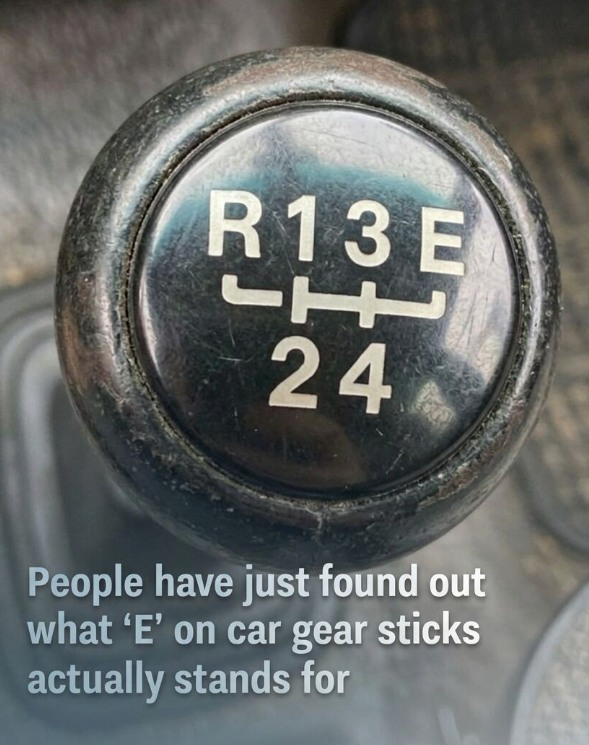
For decades, vehicle gear layouts followed familiar and easy-to-understand patterns. Manual transmissions commonly displayed numbered gears along with “R” for reverse, while automatic vehicles typically featured “P” for park, “N” for neutral, “D” for drive, and “R” for reverse. Because these systems became standard, most drivers rarely stopped to think about the meaning behind the letters and symbols on the gear selector.
That is why some drivers become curious when they notice an unusual “E” on the gear stick of certain older vehicles. Younger drivers in particular may not recognize the symbol because it has mostly disappeared from modern automobiles. However, the letter once represented an important feature connected to fuel efficiency and practical driving.
In many older cars, the “E” stood for “Economy.” This setting was designed to help reduce fuel consumption by adjusting how the engine and transmission behaved. When activated, the system often lowered engine revolutions per minute, softened throttle response, and changed shift timing to prioritize efficiency over performance.
Drivers commonly used Economy mode during highway travel or steady-speed driving conditions. The feature allowed vehicles to consume less fuel during longer trips, which was especially useful during periods when fuel prices and energy conservation became major concerns. Although acceleration felt slower, many drivers appreciated the savings at the gas pump.
The “E” setting reflects an important period in automotive history when manufacturers focused on balancing power, comfort, and fuel economy. Unlike many modern vehicles that make adjustments automatically, older cars often required drivers to choose between performance and efficiency manually. This gave drivers more direct involvement in how their vehicle operated.
As automotive technology advanced, dedicated Economy gear settings gradually became less common. Modern vehicles now rely on sophisticated computer systems capable of monitoring driving conditions in real time. These systems automatically optimize fuel use, engine performance, and transmission behavior without requiring the driver to select a separate mode.
Interestingly, the meaning of the letter “E” has evolved over time within the automotive industry. Today, many people associate it with electric vehicles and environmentally friendly transportation. The focus on efficiency remains, but the technology behind it has changed dramatically compared to earlier generations of vehicles.
Although the old Economy gear has largely disappeared, it remains a small yet meaningful reminder of automotive innovation. It represents a time when fuel-saving technology was becoming increasingly important and shows how vehicle design has evolved from simple mechanical systems to advanced computerized efficiency management.