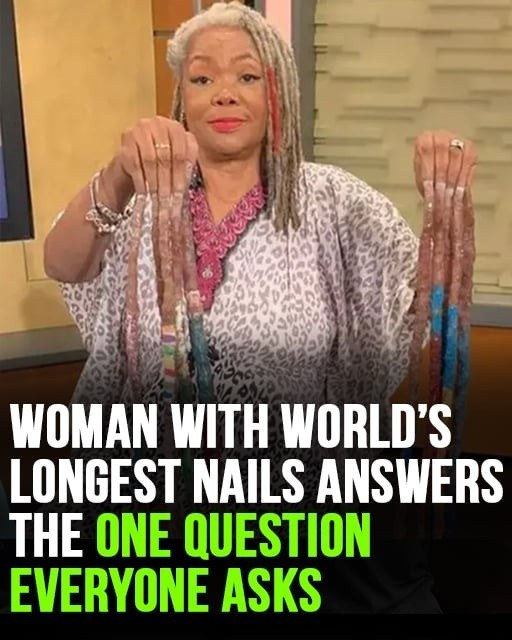
When you first lay eyes on Diana Armstrong, the immediate reaction is one of absolute shock and overwhelming disbelief. Holding the world record for the longest fingernails on a pair of hands, her nails stretch out to an astonishing length of over forty-two feet. For years, the general public has viewed her as an eccentric spectacle, a bizarre curiosity appearing in tabloid headlines and record books. People stare, point, and whisper, fascinated by the sheer physical impossibility of growing something so long and unwieldy. But behind the glittering polish and the media frenzy lies a profoundly human story of unspeakable tragedy, unwavering maternal love, and a deeply unconventional way of processing grief that few people have ever taken the time to understand.
The story behind the nails begins in the most heartbreaking way imaginable in the year 1997. Diana was a mother living a normal, joyful life, surrounded by her children. Her sixteen-year-old daughter, Latisha, was a vibrant, loving presence in the household. One night, Latisha suffered an unexpected and fatal asthma attack in her sleep. The sudden, violent loss of a child is a trauma so immense that it threatens to shatter the foundation of any person’s existence. For Diana, the shock was paralyzing. The world went dark, and the days that followed were an endless blur of tears, disbelief, and a profound, aching void. It felt impossible to move on, impossible to accept that the daughter she had loved so fiercely was simply gone.
In the depths of her despair, Diana found a coping mechanism that would become her life’s defining feature. Before that tragic night, Latisha had actually been doing Diana’s nails, painting them and polishing them during a shared moment of mother-daughter bonding. The memory of her daughter’s hands, full of life and color, became permanently etched into Diana’s mind. In a desperate attempt to keep a piece of her daughter with her, Diana made a silent, deeply personal vow. She would stop cutting her fingernails. Every single inch of growth would become a living, physical memorial to the child she had lost. The nails became a tangible manifestation of her grief, a way to channel the unbearable pain into something that could be seen, touched, and carried forward through the years.
As the years turned into a decade, and the decade stretched into multiple decades, the nails grew to unimaginable lengths. Diana stopped going to the nail salon, choosing instead to let nature take its course under her own care. Because her hands were now encumbered by feet of keratin, she was forced to step away from many of her daily chores and professional responsibilities. The maintenance of such extreme appendages became a full-time endeavor, requiring specialized tools and hours of care. But for Diana, the physical burden was a small price to pay for the spiritual connection she felt to Latisha. The nails were not a fashion statement or a bid for attention; they were an extension of her mourning, a protective shell she built around her shattered heart.
Inevitably, as the length of her fingernails reached world-record proportions, the outside world began to take notice. The spotlight found Diana, bringing with it a flood of attention, interviews, and public appearances. People were quick to judge, often labeling her as strange or obsessive. The questions they asked were frequently intrusive, born out of pure shock rather than genuine curiosity. The question everyone really wanted to ask, the one they tiptoed around, was how a person manages the most basic, intimate aspects of human existence with claws that long.
When people finally gathered the courage to ask how she managed her day-to-day life, Diana answered without a single shred of shame or embarrassment. The reality of her daily routine is a testament to human adaptation and the power of family support. Basic tasks that we take for granted require immense planning and modified movements. Zipping up a jacket, reaching for a glass of water, or opening a door all require careful consideration and unique techniques. Diana learned to use her knuckles and the sides of her hands rather than her fingertips. She relies heavily on the support of her children and grandchildren, who assist her with the things she simply cannot reach or manipulate on her own.
The bathroom habits, the eating routines, and the simple act of dressing all underwent a drastic transformation. Diana adapted. She figured out how to use her feet, her elbows, and alternative tools to accomplish what her hands could no longer do. There are trade-offs, of course, and sacrifices made to accommodate the length of her nails. She cannot drive a car, she cannot easily maneuver through crowded spaces, and she requires assistance for many of the more delicate tasks of daily living. But she accepts these trade-offs willingly, viewing them not as a burden, but as a necessary part of honoring her daughter’s memory.
To those who view her lifestyle as bizarre, Diana offers a very different perspective. She frames the nails as love made visible. They are the physical proof of a mother’s refusal to forget, a monument built out of the sheer force of a parent’s devotion. In choosing not to trim her nails, Diana did not just set a world record or become a viral sensation; she grew a deeply complex and moving story about loss, resilience, and the difficult ways we learn to live with a broken heart. Her journey reminds us that grief takes many forms, some of them strange to the outside observer, but entirely sacred to the one carrying the weight.
Today, Diana Armstrong stands as a symbol of endurance. Her record-breaking nails continue to draw attention, but the true story remains the strength of the woman attached to them. She survived the absolute worst thing a parent can ever face. She found a way to breathe, to live, and to find moments of joy again, all while carrying a physical representation of her love for Latisha. The world may look at the length of her nails, but they are looking at a monument to a love that refuses to die.