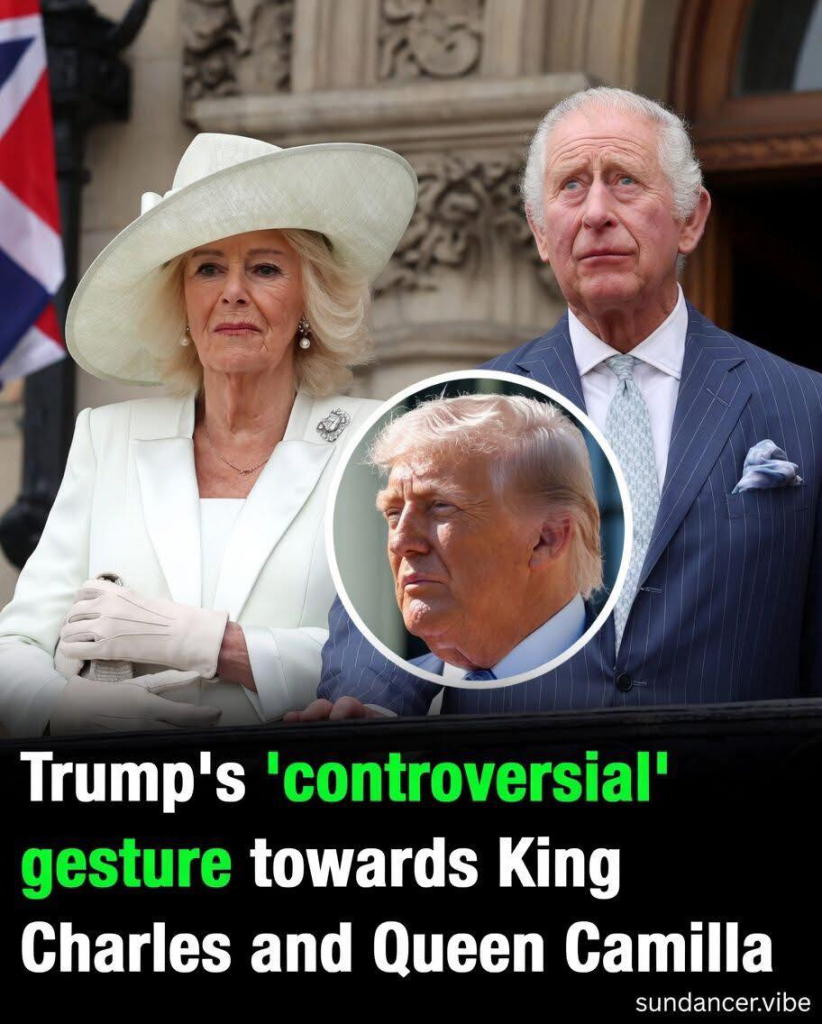
The meeting between Donald Trump and King Charles III was always going to be closely watched. Set against a backdrop of strained relations between the United States and the United Kingdom, the state visit carried far more weight than ceremonial handshakes and polite smiles. Every word, every glance—and, as it turned out, every gesture—was scrutinized.
But it wasn’t policy, speeches, or even diplomacy that captured the most attention. Instead, it was something far simpler: body language.
Images and video clips from the visit showed Trump placing a hand on King Charles’s back as they walked together, later appearing to touch his knee while seated. In another moment that quickly circulated online, he was seen lightly touching the arm of Queen Camilla.
To some, these were minor, even friendly gestures. To others, they crossed an invisible but deeply rooted line.
A visit shaped by tension
The significance of the meeting cannot be separated from the political climate surrounding it. In the months leading up to the visit, Trump had publicly criticized the U.K. government, particularly targeting Prime Minister Keir Starmer. His remarks—calling Starmer “no Churchill” and questioning Britain’s role as an ally—had strained what is often described as the “special relationship.”
So when King Charles and Queen Camilla arrived in Washington for a four-day state visit, expectations were high. The visit was seen as an opportunity to reset relations, or at the very least, to stabilize them.
In a formal address, King Charles emphasized the long-standing ties between the two nations, speaking about shared history, values, and cooperation. It was a carefully measured message, one aimed at unity rather than division.
Yet even as those words were delivered, public attention drifted elsewhere—to the more subtle signals unfolding in real time.
The moment that sparked debate
Royal protocol, while often unwritten, carries significant weight. One of its most widely recognized customs is simple: physical contact with a member of the Royal Family should be limited, and typically initiated by the royal themselves.
Handshakes are acceptable—but only when offered first. Beyond that, gestures such as touching, patting, or guiding are generally discouraged.
This is where Trump’s actions became controversial.
Supporters argued that his gestures were natural, even warm. In American culture, physical contact—such as a reassuring pat on the back—can signal friendliness, confidence, or familiarity. From that perspective, the interaction could be seen as an attempt to establish rapport.
Critics, however, viewed it differently. To them, the gestures appeared dismissive of tradition, or at least uninformed by it. The idea of touching a reigning monarch, particularly without clear invitation, struck some as a breach of decorum.
Social media quickly amplified both interpretations.
Divided reactions online
Within hours, the images had spread widely, sparking intense debate.
Some users described the gestures as “disrespectful,” arguing that they showed a lack of awareness—or disregard—for royal customs. Others framed it as part of a broader pattern, suggesting that Trump often challenges established norms.
But not everyone agreed.
A significant number of people defended the president, pointing out that cultural differences play a major role in how behavior is interpreted. What might be seen as inappropriate in one context could be perfectly normal in another.
“Not everything is an insult,” one commenter wrote. “Sometimes it’s just a different way of interacting.”
Another added that the royal family themselves did not appear visibly uncomfortable, suggesting that the reaction might be exaggerated.
This divide highlights a broader truth: in highly public moments, perception often matters as much as reality.
Protocol vs personality
At the heart of the controversy lies a clash between two worlds.
On one side is royal protocol—rooted in centuries of tradition, formality, and symbolic behavior. On the other is modern political leadership, where personality, informality, and relatability often take precedence.
Trump has long been known for his unconventional approach. Whether in speeches, negotiations, or public appearances, he tends to favor directness over formality. For supporters, this is part of his appeal. For critics, it can appear undisciplined.
The meeting with King Charles brought these contrasting styles into sharp focus.
Was Trump intentionally disregarding protocol? Or was he simply being himself in a setting that expects something different?
There’s no single answer—but the question itself reveals how much meaning can be attached to even the smallest actions.
The role of symbolism in diplomacy
Diplomatic events are rarely just about what is said. They are also about what is shown.
A handshake, a smile, a pause before speaking—these details can carry symbolic weight. They send signals not only to those present, but to audiences around the world.
In this case, Trump’s gestures became a symbol in themselves.
For some, they represented confidence and ease—an American leader comfortable on the world stage. For others, they suggested a lack of respect for established traditions.
Neither interpretation exists in isolation. Both are shaped by the viewer’s perspective, expectations, and beliefs.
Did it matter in the bigger picture?
Despite the controversy, the visit itself continued without disruption. Meetings were held, speeches were delivered, and both sides emphasized cooperation.
There were no official complaints about the interactions, and no visible signs of tension during the public appearances.
In many ways, the broader goals of the visit remained intact.
Yet the reaction to those brief moments underscores something important: in the age of instant media, even minor details can take on outsized importance.
A single image can become a talking point. A short clip can shape a narrative.
A moment that reflects a larger conversation
The discussion surrounding Trump’s gestures goes beyond etiquette. It touches on deeper questions about leadership, culture, and how public figures are expected to behave.
Should leaders strictly follow tradition when engaging with institutions like the monarchy?
Or is there room for personal style, even if it challenges expectations?
The answer likely depends on who you ask.
What is clear, however, is that moments like these resonate because they sit at the intersection of symbolism and reality. They invite interpretation, debate, and, sometimes, disagreement.
Final thoughts
In the end, what happened during the meeting between Donald Trump, King Charles, and Queen Camilla was brief—just a few seconds captured on camera.
But those seconds sparked a much larger conversation.
Not about policy or strategy, but about perception.
About how gestures are read.
About how traditions are upheld—or challenged.
And about how, in a world where every move is watched, even the smallest action can carry meaning far beyond the moment itself.