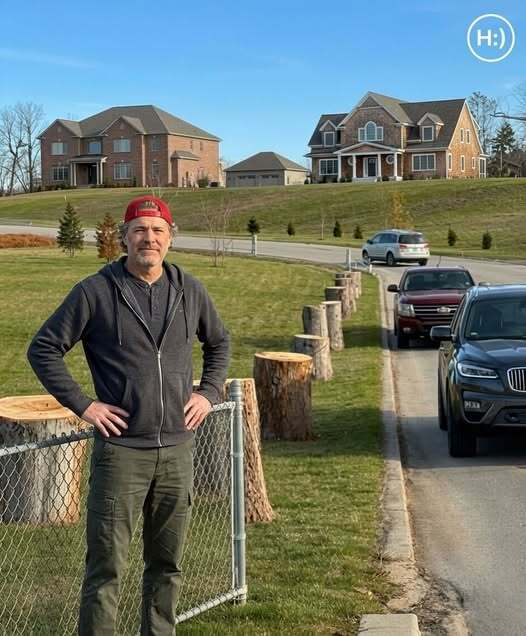
The first tree didn’t fall with enough noise to warn me. There was no call, no message, no sign that something important had been taken. Only later, when I returned home, did the absence become clear. Where there had once been a line of tall trees—planted years ago by my father—there were now six clean stumps. The space felt exposed, unfamiliar, and suddenly connected to the new houses beyond, their windows now looking directly into what used to be a private yard.
Those trees had never been just scenery. They were tied to memory, to childhood, to the quiet rhythm of summers spent in their shade. They marked a boundary, not just between properties, but between past and present. Their removal wasn’t simply physical—it erased something personal. The explanation came quickly from the nearby development. It was called a “view corridor,” a planned adjustment to improve the landscape and increase property value. But standing there, the meaning was simpler. Something had been taken without permission.
Instead of reacting immediately, I turned to old documents my family had kept. It took time, but eventually I found what mattered—an easement tied to the only road leading to those new homes. By the next morning, I had acted. A heavy chain stretched across the road, locked firmly in place. It wasn’t symbolic. It was a boundary made visible.
At first, the residents didn’t take it seriously. But as the inconvenience grew—longer routes, delayed deliveries—the situation shifted. What had been dismissed became real. When legal action followed, the facts were clear. The trees had stood entirely on my property. The damage couldn’t be explained away.
Eventually, an agreement was reached. The loss was acknowledged, and restoration began. New trees were planted—young sycamores, not replacements, but beginnings. As I watched them take root, something settled. Not satisfaction, but balance.
I removed the chain quietly. Life returned to normal, but something had changed. The land was no longer just part of a view. It was understood. And over time, as the trees grow again, they will stand not only as a boundary—but as a reminder.