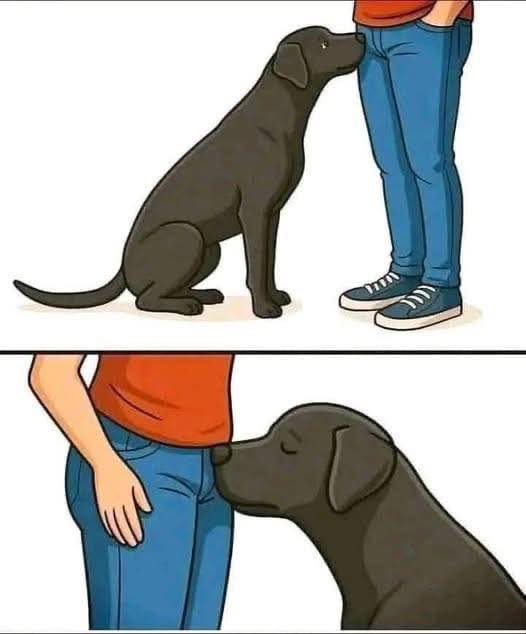
Living with a dog means learning a completely different language, one spoken not through words but through posture, movement, and, most importantly, scent. Dogs experience the world primarily through their noses, processing information in ways that humans can barely imagine. When a dog approaches a person and seems especially interested in sniffing certain areas of the body, it can feel awkward or confusing, but for the dog it is neither rude nor inappropriate. It is a deeply ingrained instinct shaped by evolution and social behavior. Dogs are not driven by embarrassment or social rules; they are driven by information. Their noses can detect subtle chemical signals that reveal identity, emotional state, stress levels, hormonal changes, and even aspects of health. What feels uncomfortable to a human is, to a dog, a straightforward attempt to understand who you are at that moment. Recognizing this difference in perception is the first step toward understanding canine behavior without projecting human emotions or assumptions onto it.
The power of a dog’s sense of smell is difficult to overstate. Dogs possess up to 300 million olfactory receptors, compared to about six million in humans, and the portion of their brain dedicated to processing scent is vastly larger than ours. This allows them to detect pheromones and chemical changes that humans cannot consciously perceive. Certain areas of the human body release higher concentrations of these chemical signals, especially areas rich in specific sweat glands. From a dog’s perspective, these scents provide a detailed snapshot of a person’s biological and emotional state. Changes in stress, excitement, illness, or hormonal balance can all subtly alter body chemistry, and dogs are exceptionally skilled at noticing these variations. This is why dogs are often able to sense fear, anxiety, or illness before a person is even aware of it themselves. Sniffing, therefore, is not random curiosity but a sophisticated form of information gathering.
In canine social structures, sniffing is a primary method of greeting and recognition. Dogs sniff one another to learn age, sex, mood, and social status, establishing context before deciding how to interact. When dogs apply this same behavior to humans, they are simply extending their natural social rules to members of their mixed-species family. To a dog, sniffing a person is comparable to a human asking, “Who are you?” and “How are you feeling today?” This behavior helps dogs feel secure and oriented in their environment. Without scent information, a dog may feel uncertain or anxious, especially in new or stimulating situations. Understanding this can help owners respond calmly rather than with embarrassment or frustration, reinforcing trust and emotional safety for the dog.
That said, understanding does not mean ignoring personal comfort or social boundaries. While the behavior is natural for dogs, humans are allowed to feel uncomfortable and set limits. The key is to address the behavior without punishment or anger, which can confuse or stress the dog. Gentle redirection through training is both effective and respectful of the dog’s instincts. Teaching commands such as “sit,” “down,” or “leave it,” and rewarding compliance with praise or treats, gives the dog an alternative way to interact. Over time, dogs learn which behaviors are acceptable in different contexts. This approach preserves the dog’s need to explore and communicate while helping them adapt to human social norms, strengthening cooperation rather than creating fear.
It is also important to understand that a dog’s interest in scent does not indicate dominance, misbehavior, or inappropriate intent. Dogs do not attach the same meanings to body parts that humans do, and interpreting their actions through a human lens often leads to misunderstanding. When a dog sniffs, they are not making judgments or acting with awareness of social taboos; they are simply reading information. Many service dogs, medical alert dogs, and therapy dogs rely on this same ability to detect chemical changes associated with medical conditions, emotional distress, or neurological events. The everyday sniffing behavior seen in household pets is part of the same biological skill set, just applied in a casual, social context rather than a trained medical one.
Ultimately, understanding why dogs behave the way they do deepens the relationship between humans and their pets. When owners recognize sniffing as communication rather than misbehavior, they are better equipped to respond with patience, empathy, and effective guidance. This understanding fosters trust and reduces frustration on both sides. Dogs thrive when their natural instincts are acknowledged and gently shaped, not suppressed or punished. By learning to interpret canine behavior accurately, owners can maintain comfort and boundaries while honoring the remarkable sensory world dogs live in. What may initially feel awkward becomes an opportunity to appreciate the intelligence, sensitivity, and social complexity of dogs, reinforcing the bond that makes human–canine relationships so enduring and meaningful.