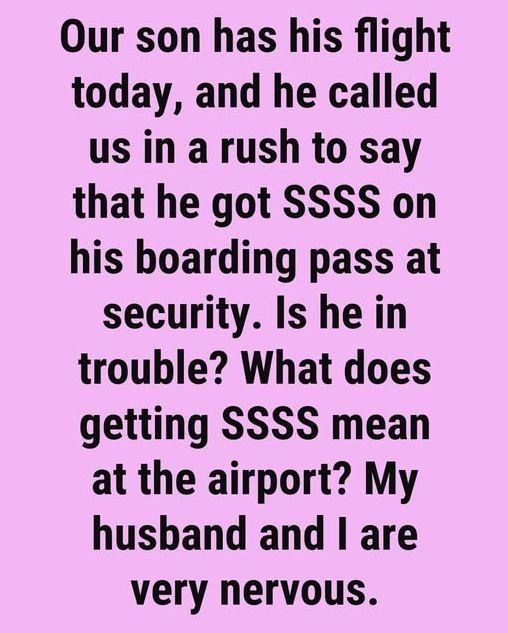
Printed your boarding pass.
Grabbed your coffee.
And then you see it—right there at the bottom of the barcode:
SSSS
Four little letters that feel like a punch to the gut.
No warning.
No explanation.
Just… extra screening.
Suddenly, your stress level skyrockets.
“What did I do?”
“Am I on a watchlist?”
“Will I miss my flight?”
Take a breath.
Let’s demystify SSSS—what it really means, why it happens, and how to get through security with calm (and maybe even a little grace).
What “SSSS” Stands For
SSSS = Secondary Security Screening Selection
It’s not a personal accusation.
It’s not proof you’re suspicious.
It’s not even about you, necessarily.
It’s a random or algorithm-driven flag used by the TSA (Transportation Security Administration) as part of the Secure Flight program—a system designed to:
Enhance aviation security
Identify potential threats before boarding
Match passenger data against government watchlists and trusted traveler databases
If your name matches certain patterns—or is randomly selected—you get the SSSS tag, which means:
You’ll undergo additional screening at the checkpoint.
What Happens During SSSS Screening?
When you see “SSSS” on your boarding pass, here’s what to expect:
Extra Pat-Down or Swabbing
TSA agents will swab your hands, luggage, and sometimes clothing for explosive residue.
You may be patted down more thoroughly than usual.
Baggage Inspection
Your carry-on will be hand-checked—even if it went through the X-ray machine.
Agents may ask you to open compartments or remove electronics.
More Questions
Simple ones like: “Is this all your luggage?” or “Have you packed this bag yourself?”
Not an interrogation—just verification.
Longer Wait Time
Add 5–15 minutes to your security process.
Best to arrive extra early (at least 2 hours before domestic flights).
Good news: This screening happens before the regular checkpoint—so once you’re through, you can proceed normally.
Why Did I Get Flagged? (Spoiler: It’s Usually Random)
The truth?
You likely did nothing wrong.
Common reasons for SSSS selection:
Random selection —part of routine security rotation
Name similarity —common names that match watchlist entries (e.g., “Ahmed Khan”)
Last-minute booking —especially one-way or international flights
Flying from high-risk regions —even if you’re a U.S. citizen
Inconsistent travel patterns —if you rarely fly or visit certain countries
It does not mean you’re banned, blacklisted, or under investigation.
Think of it like a “security lottery”—you just got picked.
Pro Tips If You Have SSSS on Your Boarding Pass
Arrive
90–120 minutes early
Extra screening takes time—don’t rush!
Wear easy-to-remove shoes & minimal metal
Speeds up the process Keep liquids in a clear quart-sized bag
Ready for inspection
Stay polite and cooperative
Agents are doing their job—kindness goes far
Don’t panic or argue
It’s temporary—and very common
Fun fact: Frequent flyers, celebrities, and even TSA employees sometimes get SSSS. It’s not personal.
Final Thought: Security Isn’t Punishment—It’s Protection
Yes, being flagged is stressful.
Yes, it feels unfair.
But remember:
This system exists so that everyone on your flight feels safer.
And while the process isn’t perfect, it’s designed to cast a wide net—not to target individuals.
So when you see “SSSS”?
Don’t dread it.
Prepare for it.
Because in 15 minutes, you’ll be past security—just like everyone else.
And hey…
Maybe you’ll even earn a quiet “Thanks for your patience” from a TSA agent.
(They notice calm travelers.)