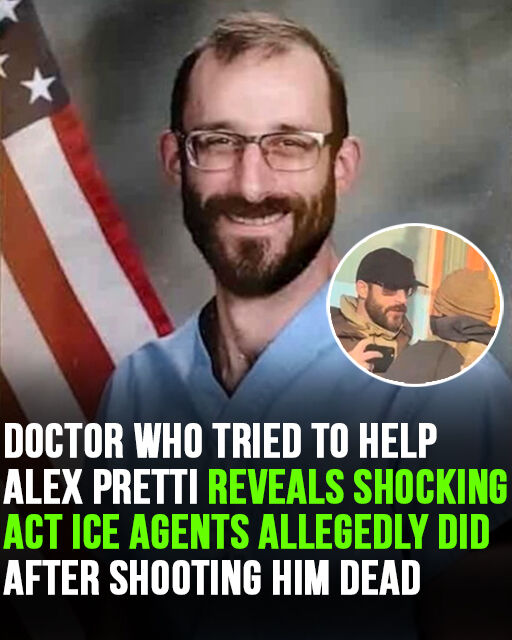
The fatal shooting of Alex Pretti in Minneapolis has sent shockwaves across the country, not only because another U.S. citizen lost his life during a federal enforcement operation, but because of what allegedly happened in the moments that followed. Pretti, a 37-year-old ICU nurse and lawful gun owner, was present amid heightened tensions in the city as protests continued over aggressive immigration enforcement tactics. Videos circulating online show a chaotic confrontation between Pretti and ICE agents, culminating in him being forced to the ground and shot multiple times. While federal officials quickly framed the incident as an act of self-defense, the narrative began to unravel when a physician who witnessed the aftermath came forward with a sworn statement. According to this doctor, instead of immediately providing life-saving aid after the shooting, ICE agents allegedly focused on counting Pretti’s bullet wounds. That claim has ignited outrage because it shifts the focus from the split-second decision to use force to the critical minutes afterward, when duty of care and basic medical responsibility should have taken precedence. For many Americans, this detail transformed the incident from a disputed use-of-force case into a deeper moral and institutional crisis.
The shooting occurred against a backdrop of mounting anger in Minneapolis, where federal immigration operations have intensified in recent weeks. Less than a month earlier, the city was already reeling from the death of Renee Nicole Good, a 37-year-old mother shot by an ICE agent during a separate confrontation. Together, the two deaths created a sense that federal law enforcement actions were spiraling beyond control, eroding trust not only among immigrant communities but among residents more broadly. Alex Pretti’s presence at the scene was not as a target of immigration enforcement but as a citizen caught in the crosscurrents of protest, authority, and fear. As an ICU nurse, Pretti’s professional life revolved around saving others, a fact repeatedly emphasized by his family as they struggled to reconcile his death with official claims portraying him as a threat. The rapid pace at which federal agencies issued statements labeling the shooting as justified, before independent investigations could take place, only deepened public skepticism. In an environment already shaped by grief and protest, the sense that conclusions were being drawn too quickly became another source of anger. The Department of Homeland Security stated that the ICE agent who fired the fatal shots acted in self-defense and that Pretti was in possession of a handgun. That assertion was immediately complicated by statements from Minneapolis Police Chief Brian O’Hara, who confirmed that Pretti was believed to be a lawful gun owner with a valid permit to carry. At the time of reporting, no evidence had been released showing Pretti aiming or firing a weapon at agents. This discrepancy between federal claims and local law enforcement assessments highlighted the uncertainty surrounding the incident. For Pretti’s family, the implication that he intended harm was deeply painful. They issued statements insisting that he posed no threat and urging the public to help uncover the truth. In similar fashion to the earlier Renee Good case, critics noted a pattern in which federal agencies appeared to frame victims as dangerous immediately after deadly encounters, shaping public perception before all facts were known. This pattern has become a focal point for civil rights advocates, who argue that narrative control following lethal force incidents undermines accountability.
The physician’s eyewitness testimony has become central to the controversy. In a statement filed in federal court, the doctor described seeing Pretti yelling at ICE agents but not attacking them or brandishing a weapon. According to the account, an agent shoved Pretti to the ground, after which multiple agents drew their firearms. The witness reported seeing at least four agents point guns at Pretti and then firing six or seven shots. What followed, however, is what has disturbed many observers most deeply. The doctor stated that they attempted to provide medical assistance but were confused by how Pretti was positioned and by the actions of the agents. The physician explained that standard emergency protocol involves checking for a pulse, securing the airway, and administering CPR when necessary. Instead, the witness claimed, agents appeared to be counting Pretti’s bullet wounds. To a medical professional, this behavior was not only unusual but profoundly troubling. The allegation suggests that once the shooting ended, the immediate priority may not have been preserving life, a possibility that has fueled widespread outrage and demands for answers.
Federal officials have strongly rejected suggestions of misconduct, with Border Control even claiming that Pretti was attempting to “massacre law enforcement,” a statement that further polarized public opinion. Critics argue that such language is inflammatory and unsupported by publicly available evidence, while supporters of ICE insist that agents operate under constant threat and must secure scenes before rendering aid. Even so, many law enforcement experts acknowledge that once a suspect is subdued and no longer posing a threat, providing or facilitating medical care is a fundamental responsibility. The doctor’s account therefore raises not only factual questions but ethical ones, forcing the public to confront how enforcement priorities are balanced against human life. Civil rights organizations have called for the release of all body-camera footage, radio communications, and medical timelines to clarify what happened between the final gunshot and the arrival of paramedics. The case has also prompted renewed scrutiny of training standards for federal agents operating in civilian environments.
As investigations continue, the death of Alex Pretti is increasingly seen as emblematic of broader national tensions surrounding immigration enforcement, policing, and accountability. Minneapolis has become a focal point for these debates, with protests continuing and legal challenges mounting. For many residents, the issue is no longer limited to whether the shooting itself was justified, but whether the systems in place adequately protect life, ensure transparency, and prevent the dehumanization of those caught up in enforcement actions. Pretti’s family has appealed directly to the public, asking for help in ensuring that his death is not reduced to competing press releases. Their plea resonates with a nation grappling with declining trust in institutions and growing fear that power is exercised without sufficient oversight. In that sense, the physician’s shocking allegation has taken on symbolic weight, representing a moment where compassion and protocol may have failed when they were needed most.
The story of Alex Pretti is still unfolding, but its implications are already clear. It raises profound questions about how authority is exercised during moments of chaos, how narratives are constructed after lethal force is used, and whether the obligation to preserve life remains central once a confrontation ends. For supporters of stricter enforcement, the case underscores the dangers agents face in volatile situations. For critics, it reinforces fears of unchecked power and a lack of accountability. Between these perspectives lies a grieving family, a shaken community, and a nation once again forced to examine the cost of enforcement policies when they intersect with human lives. As courts, investigators, and the public seek clarity, the hope shared by many is that truth, transparency, and responsibility will prevail, ensuring that Alex Pretti’s death leads not only to answers, but to meaningful reflection and change.