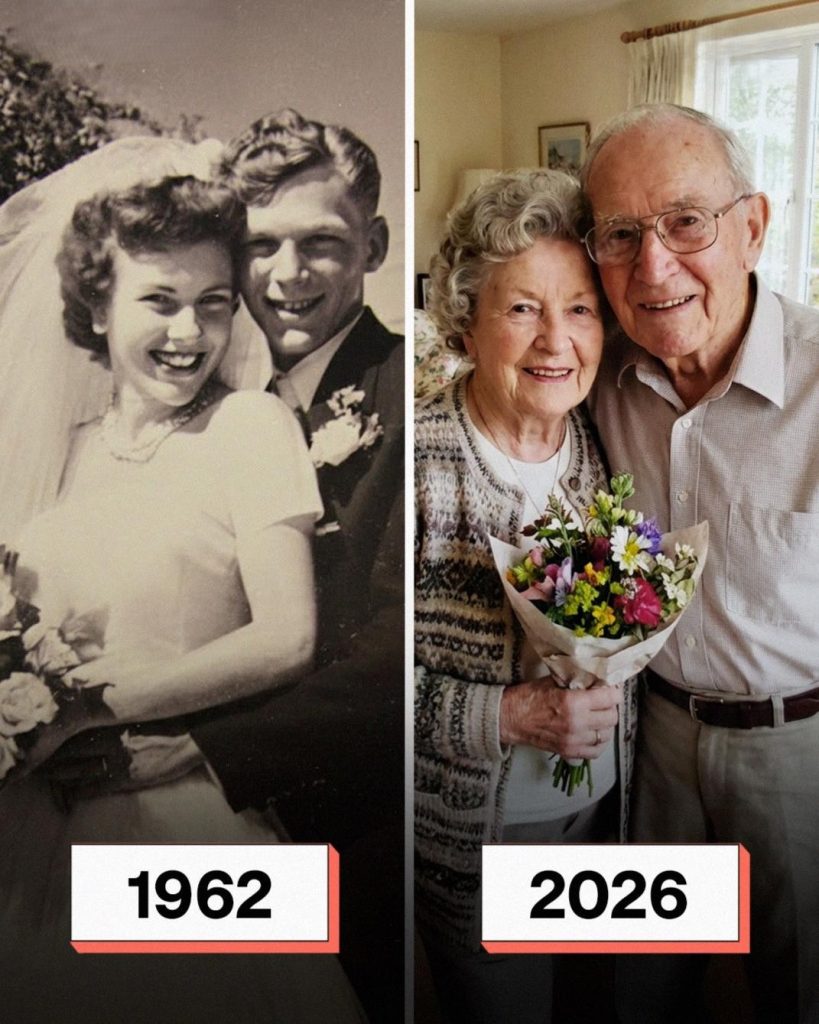
My name is Daisy. I am 83 years old, and I have been a widow for four months. Four months is not a long time when you measure it against sixty-three years of marriage. It is barely a breath.
And yet it has stretched endlessly, wide and hollow, like a house with all the windows open in winter. Robert proposed to me on Valentine’s Day in 1962.
We were twenty years old, living in a cramped student apartment just off campus. We shared a tiny kitchen with two other couples, and no matter how often we scrubbed it, it always smelled faintly of burned toast and overboiled coffee. That night he insisted on cooking.
He made spaghetti with jarred tomato sauce and garlic bread that was charred on one side and pale on the other. He lit a single candle in an empty soda bottle and apologized at least five times for the uneven pasta.
After dinner, he handed me a small bouquet of grocery-store roses wrapped in newspaper to keep them warm from the February wind. Then he pulled out a simple silver ring he had paid for with two weeks of dishwashing wages from the campus cafeteria.
His hands were shaking.
“Daisy,” he said, voice steady only because he forced it to be, “I don’t have much yet. But I will. And I want to build it with you.”
I said yes before he finished the sentence.
From that day forward, he never missed a Valentine’s Day.
Not once.
Some years it was wildflowers he picked himself from the side of a country road when money was tight and our children were small. Some years it was elegant long-stemmed roses delivered to the house when his business was thriving.
One year, when a late frost ruined his carefully planned surprise garden blooms, he showed up with carnations and a sheepish grin, saying, “They’re sturdy. Like us.”
The year we lost our second baby, he brought daisies instead of roses.
I remember that February as if it were pressed between pages. The grief had settled into me like heavy fog. I could barely stand to look at the calendar. When he walked through the door with a bouquet of white daisies, I broke down in his arms.
“Even in the hard years,” he whispered into my hair, “I’m here.”
The flowers were never just flowers. They were a ritual. A promise renewed annually. Through arguments about money, through sleepless nights with colicky babies, through layoffs, illnesses, aging parents, and all the ordinary storms of a long marriage, he always came back with flowers.
Robert died in the fall.
A heart attack. The doctor said it was quick.
Quick for him.
Not for me.
One moment we were arguing gently about whether the tomatoes in the garden needed covering before the frost. The next, he was gripping the edge of the kitchen counter, his face drained of color. By the time the ambulance arrived, the world had already shifted in a way I did not yet understand.
The house grew unbearably quiet after that.
His slippers remained beside the bed, angled outward as if waiting for his feet. His coffee mug still hung on its hook, a faint ring of brown staining the inside.
Every morning, for weeks, I set out two cups of tea out of habit. It took several seconds before memory corrected me. Only one pair of hands remained to lift a cup.
Grief is not always loud. Sometimes it is the sound of a refrigerator humming in a room that used to hold conversation. Sometimes it is the sight of a coat hanging by the door long after its owner has gone.
When Valentine’s Day approached, I felt dread more than sadness. February 14th had been ours for more than six decades. I did not know how to meet it alone.
That morning, I lay in bed staring at the ceiling, bracing myself for the emptiness of the first Valentine’s Day without him. I eventually rose, wrapped my cardigan tightly around my shoulders, and made tea. I sat at the kitchen table, staring at his empty chair.
Then someone knocked.
The sound startled me. I was not expecting anyone. My children had called the night before, promising to visit later in the week. There were no scheduled deliveries.
I walked slowly to the door and opened it.
No one stood there.
Just a bouquet of roses resting on the welcome mat. Wrapped in brown paper and tied with twine. Just like in 1962.
For a moment I could not move. The winter air brushed my cheeks, sharp and real, grounding me. I bent down and picked up the bouquet. My hands trembled.
Tucked between the stems was an envelope.
Inside was a letter in Robert’s unmistakable handwriting.
And a key.
“My love,” it began, “if you’re reading this, I am no longer by your side.”
The words blurred. I had to sit down immediately, the bouquet still clutched in my lap.
“There is something I have hidden from you our entire life,” the letter continued. “I am sorry, but I could not do otherwise. In this envelope is the key to an apartment. You must go there.”
Hidden?
The word struck like a sudden cold draft.
My mind raced backward through decades. Business trips that lasted an extra day. Late nights at the office. A phone call once taken outside in the rain, his voice low and urgent. I had asked him, long ago, if there was anything he wasn’t telling me.
“Nothing you need to worry about,” he had said, kissing my forehead.
Had there been someone else?
The thought made me physically ill. After sixty-three years, could there have been a second life parallel to mine? A child? A secret family? The betrayal would have shattered everything I believed about us.
But beneath the fear was something else. The steadiness of the man I had known. The man who never missed Valentine’s Day. The man who brought daisies when grief hollowed me out.
Still, I needed the truth.
I called a taxi. My hands shook so badly I had to dial the number twice. When the car arrived, the young driver tried to make polite conversation, but I barely heard him. I stared at the key in my palm, cool and heavy.
We drove across town to a quiet neighborhood I had never visited. Tree-lined streets. Brick buildings with tidy front steps. It was an ordinary place, not dramatic, not secretive.
The building number matched the one written in Robert’s letter.
It had a green door.
I stood on the sidewalk for several long minutes before climbing the steps. My heart pounded as though I were about to confront a stranger. I inserted the key into the lock. It turned smoothly.
The smell met me first.
Polished wood. Old paper. Something faintly sweet and dusty.
Then I understood.
Sheet music.
I stepped inside and closed the door behind me. The room was modest but warm. Sunlight filtered through half-drawn curtains. When I reached for the light switch, my hand brushed against framed photographs on the wall—not of people, but of concert halls and pianos.
The overhead light flicked on.
In the center of the room stood a beautiful upright piano. Dark wood, gleaming, clearly cared for. The walls were lined with shelves filled with sheet music, music theory books, and neatly labeled recordings stacked in careful rows.
On the piano bench sat a stack of pages.
I picked one up.
“Clair de Lune.”
My favorite piece. I had mentioned that once, decades ago, when we were newly married and I still played occasionally in the evenings.
On the music stand rested “Moonlight Sonata.”
Another favorite.
On a small table beside the piano were dozens of recordings, each labeled in Robert’s careful handwriting:
“For Daisy – December 2018.”
“For Daisy – March 2020.”
“For Daisy – July 2022.”
They stretched back years.
My throat tightened until it hurt.
Beside the recordings lay medical reports. Dated six months before he died.
Severe heart condition. Limited time. Recommended treatment plans.
Robert had known.
He had known he might not have long, and he had said nothing.
There was also a formal agreement with the building’s caretaker, instructing him to deliver the flowers and the key on the first Valentine’s Day after Robert’s passing. The instructions were specific. Timed. Paid in advance.
He had planned even that.
A leather-bound journal rested near the edge of the piano. I opened it carefully.
“Today Daisy mentioned her old piano,” one entry read, dated twenty-five years ago. “She said she once dreamed of being a pianist. She laughed when she said it, but I saw the sadness.”
I remembered that afternoon. I had been cleaning the attic and found my childhood sheet music in a box. I played a few hesitant notes on our old, out-of-tune piano before closing the lid. Life had been too full of children, bills, responsibilities.
I had let the dream go.
He had not.
“I’ve decided to learn piano,” another entry said. “I want to give her back the dream she gave up.”
I covered my mouth as a sob escaped me.
Page after page described his lessons. His embarrassment at being the oldest beginner in the studio. His frustration at stiff fingers and slow progress. His determination.
“My teacher says my timing is improving,” one entry noted proudly. “I hope Daisy would laugh at how serious I look.”
“Daisy never gave up on me,” another read. “I will not give up on this.”
Near the end, the handwriting grew shakier.
“My hands tremble now,” he wrote. “The doctor says I am running out of time. I must finish one more piece.”
The final entry was dated one week before he died.
“I am sorry, my love. I could not finish.”
On the music stand sat a handwritten composition titled “For My Daisy.”
It was beautiful. Gentle. Intricate. The melody carried familiarity, as though he had woven fragments of my favorite pieces into something new.
And it was unfinished.
The notes stopped halfway down the second page.
I sat slowly at the piano bench. It creaked softly beneath me. Dust floated in a narrow beam of light from the window.
My fingers hovered uncertainly above the keys.
I had not touched a piano in sixty years.
The first notes were hesitant, uneven. My hands felt foreign to me. But as I moved carefully through the written measures, something shifted.
Muscle memory returned quietly, like an old friend stepping back into the room without announcement. My posture straightened. My breathing slowed.
The melody Robert had written unfolded beneath my hands—full of longing and quiet devotion.
When I reached the unfinished measure, I paused.
The silence felt sacred.
Then I continued.
I let my fingers search for resolution. I softened the tension he had built. I extended the phrase the way I believed he intended. I added harmony where the melody called for support. I allowed instinct and memory to guide me.
When the final chord settled into silence, I remained seated, tears streaming freely down my face.
Behind the music stand was one last envelope.
“My darling Daisy,
This piano is yours. This studio is yours. Play again.
Even though I am gone, I am still here. In every note. In every chord.
I loved you at twenty. I loved you at eighty. I will love you forever.
Always yours, Robert.”
I pressed the letter to my chest.
He had not hidden another life.
He had built a secret dream for me.
Now I visit the studio twice a week.
Sometimes I practice scales like a stubborn beginner, laughing at my stiff fingers. Sometimes I sit quietly and listen to his recordings, imagining him hunched over the keys, determined and slightly off-tempo, starting over again and again until he got it right.
Last week, I recorded my first piece in sixty years.
My hands are slower now. The notes are not perfect. But I labeled the recording carefully:
“For Robert.”
I placed it on the shelf beside his.
For sixty-three years, he brought me flowers.
This year, from beyond, he brought me back to myself.