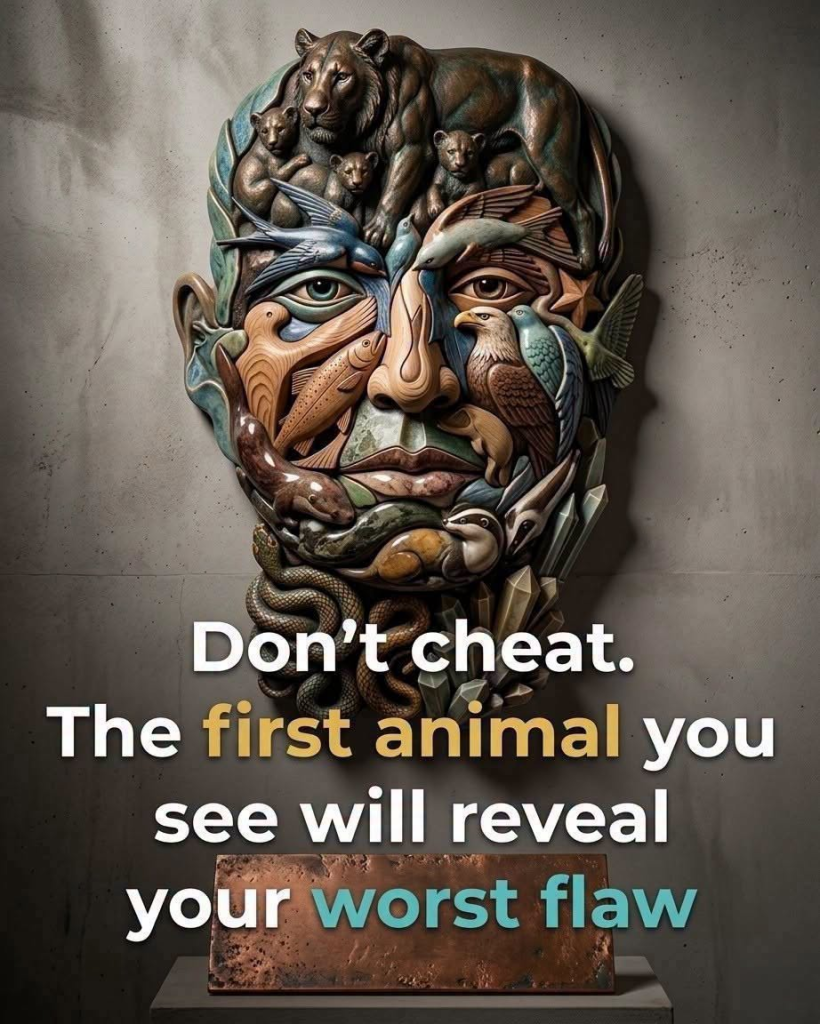
Have you ever wondered why you repeat certain patterns in life, struggle with relationships, or feel controlled by hidden traits you can’t quite name? Viral “psychological illusion” tests claim these patterns can be revealed in seconds through simple visual choices.
One of the most popular formats is the “first animal you see” image test. You’re shown a complex illustration and asked to identify the first animal that stands out. The idea is that your brain reveals subconscious tendencies through instinctive perception.
These tests are often compared loosely to Rorschach-style exercises. When faced with ambiguous images, the human brain naturally imposes order on chaos, prioritizing certain shapes and details based on attention, memory, and bias.
Different interpretations are said to reflect different personality traits. For example, seeing a lion may be linked to pride or dominance, while a rabbit is associated with sensitivity or anxiety. A bird can symbolize independence, a snake mistrust, and an elephant strong memory or attachment to the past.
However, these interpretations are not scientifically validated. They are typically built on symbolic associations rather than clinical psychology and should be understood as entertainment rather than diagnostic tools.
Much of their popularity can be explained by the Barnum Effect, where people relate to vague or general statements because they feel personally accurate. This is why many quiz results seem meaningful even when they are broadly applicable to almost anyone.
Despite this, such tests can still encourage self-reflection. They may prompt people to consider their habits, emotions, or reactions more thoughtfully, even if the underlying mechanism is not scientifically rigorous.
Ultimately, the value of these viral illusions lies not in accuracy but in perspective. They highlight how differently people perceive the same image and remind us that self-understanding often comes from reflection, not quick answers.