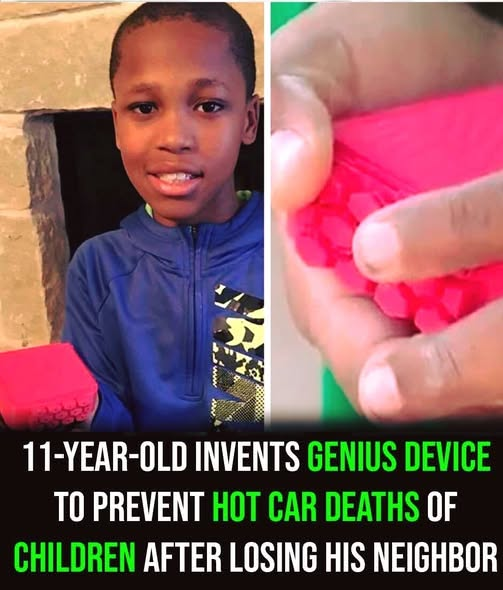
In Texas, a powerful story of innovation and compassion emerged when a young boy turned personal empathy into an attempt to solve a tragic real-world problem. Bishop Curry, an 11-year-old student, became widely recognized after he developed an idea for a device designed to help prevent hot car deaths involving children. His motivation came from a heartbreaking incident in his own community that deeply affected him and sparked his desire to take action.
The tragedy that inspired Bishop involved the death of a six-month-old baby who had been left inside an overheated vehicle. The incident, which occurred near his family’s home, left a strong emotional impact on him. Rather than simply processing the event as a distant news story, Bishop found himself thinking about how similar situations could be prevented in the future. He later explained in interviews that the experience made him feel strongly that he wanted to contribute to saving lives in some meaningful way.
Hot car deaths have unfortunately been a long-standing issue in the United States. Research from organizations such as NoHeatstroke.org has documented that more than a thousand children have died from heatstroke in vehicles since the late 1990s. These incidents often occur when a child is unintentionally left behind in a car, and rising interior temperatures quickly become life-threatening. This broader context helped shape the urgency behind Bishop’s thinking and his desire to develop a preventative solution.
Bishop was already known within his family as a creative child who enjoyed building and imagining inventions. Before focusing on his most well-known idea, he had experimented with other playful projects such as small mechanical devices and simple engineering concepts. However, after learning about the nearby tragedy, his focus shifted toward something far more serious and potentially life-saving.
He began sketching ideas for a system that could detect when a child had been left inside a vehicle and respond to dangerous temperature changes. He shared these early concepts with his father, Bishop Curry IV, who works in engineering at Toyota. His father immediately recognized the seriousness and potential of the idea, even though it came from a child. This collaboration marked the beginning of what would become the “Oasis” concept.
Together, father and son began refining the idea into a more structured prototype. The device was envisioned as something that could attach to a child’s car seat and monitor conditions inside the vehicle after the engine was turned off. If the system detected that a child was still present and temperatures were rising, it would activate a cooling response and send alerts to caregivers.
According to descriptions shared in interviews, the device was designed to function in multiple stages. First, it would attempt to cool the interior space around the child using a built-in air system. At the same time, it would send notifications to the parents or guardians to alert them that the child had been left inside the vehicle. If no response followed, the system could escalate by contacting emergency services, adding additional layers of protection.
Bishop described the communication system in a simple way during interviews, comparing it to sending messages “like texting, but without emojis.” This explanation reflected his age and perspective, but also helped make the concept easier for the public to understand. The idea combined childlike creativity with practical engineering thinking, which is part of what made the story widely shared.
As interest in the project grew, Bishop and his father created a 3D model of the proposed device. They began exploring the steps required to turn it into a real product, including patent applications and early-stage development. However, they quickly realized that transforming an idea into a manufactured safety device involves significant costs and legal processes.
To help move the project forward, the family turned to crowdfunding. They launched a campaign expecting only modest support, not anticipating widespread attention. However, the response from the public exceeded all expectations, with supporters contributing tens of thousands of dollars within a relatively short period of time. The campaign eventually raised close to $100,000, providing resources for patent filings and continued development.
Bishop’s father expressed surprise at the level of support, noting that they initially expected only a small amount of donations. He explained that much of the encouragement seemed to come from people who were moved by the idea of a child trying to solve a serious safety issue. The public response highlighted how powerful stories of youth innovation can be when combined with real-world problems.
With funding in place, the family proceeded with submitting documentation to the U.S. Patent and Trademark Office. While the device had not yet reached full production or commercialization, the process marked an important step toward turning Bishop’s idea into a potential real-world safety tool. The journey also demonstrated how innovation can begin at a very young age when curiosity meets personal motivation.
Bishop has continued to speak about his inspiration, emphasizing that the idea came from seeing the impact of a tragedy in his community. He has expressed hope that his concept could one day help prevent similar incidents and protect families from experiencing such loss. His perspective reflects a simple but powerful belief that children can contribute meaningful ideas when they observe the world around them without bias.
The story of Bishop Curry and his “Oasis” invention remains an example of how creativity, empathy, and engineering can intersect. While the device itself is still in development and not yet widely available, the idea has already made a significant impact by raising awareness about hot car dangers and encouraging discussions about prevention technologies.