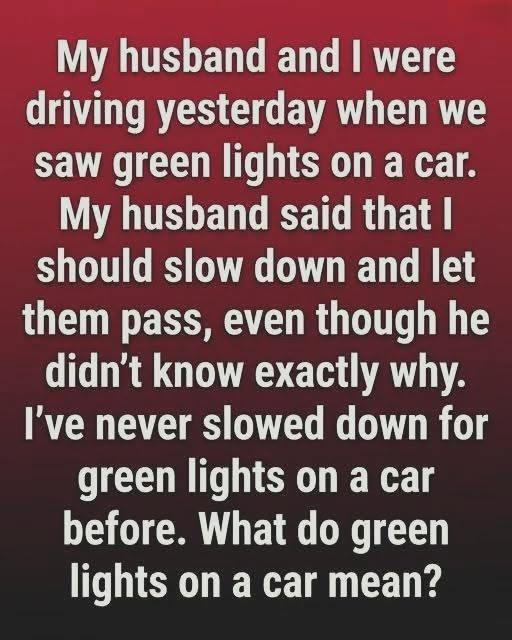
Driving at night often demands heightened attention, especially when visibility is reduced and unexpected lights appear in the distance or in a rearview mirror. Most drivers are familiar with standard emergency signals such as red and blue flashing lights, which are widely associated with police, fire, or ambulance services. However, in some regions, drivers may occasionally encounter vehicles displaying green flashing lights, which can create confusion for those unfamiliar with their meaning.
Understanding what these signals represent is important for maintaining calm and safe driving behavior. Green flashing lights on vehicles are not universally standardized across all countries or regions. Unlike red and blue lights, which are commonly reserved for emergency response vehicles, green lights may be used for different purposes depending on local regulations.
In some areas, they can be associated with volunteer emergency responders, medical transport support vehicles, or other authorized services. Because of this variation, drivers may interpret them differently if they are not aware of local traffic laws. When an unexpected flashing light appears behind a vehicle, it can naturally cause a moment of uncertainty for drivers.
The human brain is trained to respond quickly to visual signals, especially those associated with urgency or authority. This reaction is part of natural defensive driving awareness. However, not all flashing lights indicate an immediate emergency requiring sudden action. In the case of green lights, the situation is often informational rather than commanding.
In most traffic systems, only specific emergency vehicles are granted legal priority on the road. These typically include ambulances, fire trucks, and police vehicles using officially regulated light and siren combinations. Green lights, where permitted, generally do not grant the same legal right-of-way. This means that ordinary traffic rules still apply to both the driver using the green light and surrounding motorists. Understanding this distinction helps reduce unnecessary panic or abrupt driving decisions.
For everyday drivers, the safest response when encountering any unfamiliar vehicle lighting is to remain calm and maintain steady control of the vehicle. Sudden braking, erratic lane changes, or unpredictable movements can increase the risk of accidents, especially on highways or in heavy traffic conditions. Instead, drivers are advised to continue driving normally while staying aware of the vehicle’s position in traffic.
Defensive driving principles emphasize predictability. When drivers maintain consistent speed and lane positioning, they create a safer environment for everyone on the road, including nearby vehicles that may be using special lighting for visibility purposes. This approach allows all road users to navigate traffic more smoothly without unnecessary disruption or confusion.
In some regions where green lights are officially used, they may serve primarily as a visibility aid rather than a command signal. For example, they can help identify vehicles that require additional visibility due to their role in transport services or other non-emergency support functions. In such cases, the lighting is designed to make the vehicle more noticeable in low-light conditions rather than to instruct other drivers to yield immediately.
It is also important to recognize that road safety depends heavily on public awareness and education. Many misunderstandings arise simply because drivers are not fully informed about the meaning of different lighting systems. While most people are familiar with emergency blue and red lights, fewer are aware of regional variations such as green or amber signals used for specific purposes.
Traffic authorities in many regions encourage drivers to stay informed about local regulations regarding vehicle lighting. These rules are designed to ensure that all road users understand how to respond appropriately in different situations. Clear knowledge reduces confusion and helps prevent unnecessary stress or dangerous reactions while driving.
Another key aspect of road safety is maintaining situational awareness. Drivers should regularly check mirrors, monitor surrounding traffic, and remain attentive to changes in their environment. When a vehicle with unusual lighting appears, the correct approach is to observe calmly, assess its movement, and adjust driving behavior only if necessary for safety reasons.
Green flashing lights, where used legally, are not intended to create fear or urgency among other drivers. Instead, they function as a communication tool within traffic systems. Like other forms of vehicle signaling, their purpose is to improve visibility and awareness rather than to introduce confusion or alarm. Understanding this helps reduce misinterpretation on the road.
From a broader perspective, modern traffic systems rely on shared understanding and cooperation between drivers. Every vehicle on the road is part of a larger network that functions best when participants follow predictable and lawful behavior. Whether dealing with emergency vehicles, transport services, or standard passenger cars, consistency and awareness are essential.
Misinterpretation of unfamiliar signals can sometimes lead to unnecessary anxiety, especially during nighttime driving when visibility is limited. However, most traffic situations can be safely managed by relying on established driving rules rather than reacting emotionally to unexpected stimuli. Calm decision-making is one of the most important factors in preventing road incidents.
Ultimately, green flashing lights on vehicles serve as a reminder that traffic systems can vary across regions and that drivers should remain informed and adaptable. While they may appear unusual at first glance, they are generally part of regulated systems designed for specific local purposes. Recognizing this helps reduce confusion and encourages safer driving behavior.
In conclusion, encountering a vehicle with green flashing lights should not automatically be interpreted as an emergency situation. Instead, drivers should remain calm, continue driving safely, and stay aware of their surroundings. By following basic principles of defensive driving and respecting traffic laws, road users can ensure a safer experience for themselves and others. Understanding different vehicle signals is part of becoming a more responsible and informed driver in today’s complex traffic environment.