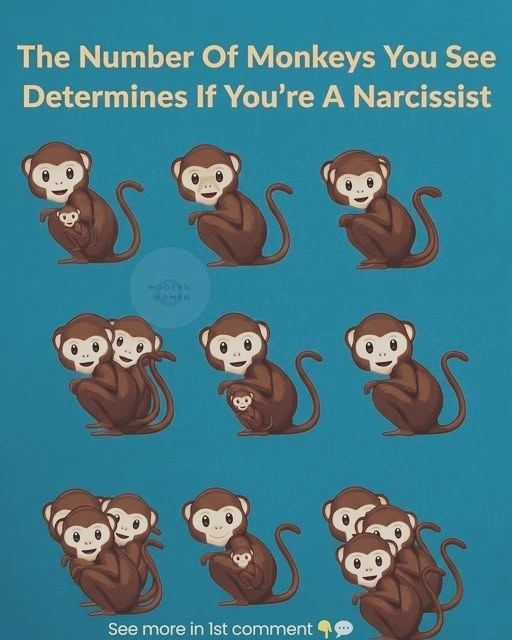
In recent years, social media platforms have seen a rise in viral optical illusions and visual puzzles that claim to reveal hidden aspects of personality. One of the most widely shared examples involves an illustrated grid of monkeys that users are asked to count within a short time limit. This type of content spreads quickly because it combines curiosity, self-reflection, and entertainment. People are naturally drawn to challenges that seem to offer insight into their own personality or cognitive style through a simple visual task.
The “monkey counting” image is typically presented with bold claims suggesting that the number of faces a person sees or counts can reveal traits such as empathy, attention to detail, or even narcissistic tendencies. However, these interpretations are not based on any established psychological diagnostic method. Clinical psychology does not use optical illusions or visual counting tests to evaluate personality disorders or mental health conditions.
Instead, personality psychology relies on validated instruments such as standardized questionnaires, structured interviews, and long-term behavioral observation conducted by trained professionals. Despite the lack of scientific evidence, viral personality tests remain popular because they offer a sense of immediate self-discovery. They create the illusion that complex human traits can be understood through simple, accessible challenges.
The appeal of these tests is closely tied to human curiosity about identity. Many people enjoy categorizing themselves into frameworks such as personality types, behavioral styles, or cognitive profiles. This desire for self-understanding has existed long before social media, but digital platforms have amplified it by turning psychological concepts into shareable, interactive content.
In the case of visual puzzles like the monkey grid, users are often encouraged to count how many figures they can identify within a limited time frame. The result is then loosely interpreted as a reflection of cognitive style. Some versions of the viral explanation suggest that people who notice fewer figures are “big-picture thinkers,” while those who find more details are “detail-oriented observers.” These interpretations are symbolic rather than scientific.
Psychologists explain that differences in what people see in optical illusions are usually related to perception, attention, and cognitive processing speed rather than personality traits or emotional characteristics. Human vision does not function like a perfect recording device. Instead, the brain actively filters, organizes, and simplifies visual information to make sense of complex environments quickly.
This process is known as perceptual organization, and it is a normal function of the visual system. It helps individuals focus on relevant information while ignoring unnecessary details. One relevant concept in psychology is Gestalt perception, which describes how the brain groups similar shapes and patterns into unified forms rather than processing every detail separately.
When looking at complex images, some individuals naturally prioritize overall structure, while others focus on smaller components within the scene. Both approaches are normal variations in cognitive style. Time pressure can also influence perception. When people are asked to complete a visual task quickly, they are more likely to rely on mental shortcuts rather than detailed analysis.
These shortcuts are not signs of personality flaws but efficient cognitive strategies that help the brain conserve energy and process information rapidly. Because of this, two people looking at the same image may report different counts or interpretations without either being more “accurate” in a psychological sense.
Modern viral content often exaggerates these differences by assigning emotional or moral meaning to neutral cognitive variations, which can create misunderstandings about human psychology. It is important to distinguish between entertainment-based online quizzes and clinically validated psychological assessments used in mental health evaluation.
Conditions such as personality disorders, including narcissistic personality disorder, are diagnosed through comprehensive clinical criteria that involve long-term patterns of behavior and interpersonal functioning. These conditions cannot be identified through brief visual exercises or internet-based personality challenges, regardless of how convincing their descriptions may appear.
Psychologists emphasize that personality is complex and cannot be accurately reduced to a single image, test, or viral interpretation. Instead, personality is shaped by a combination of genetics, environment, life experience, and cognitive development over time.
While viral puzzles can be fun and engaging, they should be understood as entertainment tools rather than diagnostic instruments or scientific evaluations. The popularity of these tests reflects a broader cultural trend in which psychological language is often used informally to describe everyday experiences.
Terms like “narcissist,” “empath,” or “overthinker” are frequently used online in ways that differ significantly from their clinical meanings. This simplification can make psychological concepts more accessible, but it can also lead to misinformation when casual labels are treated as professional diagnoses.
In reality, traits such as empathy, attention to detail, and self-focus exist on broad spectrums rather than in fixed categories determined by a single visual test. Every individual uses a combination of global and detailed processing depending on context, task demands, and cognitive focus at the moment.
This flexibility is part of normal human cognition and is not indicative of any fixed personality classification. Ultimately, optical illusions and visual puzzles like the monkey image are best appreciated as entertainment that highlights how differently people can perceive the same information. They can be useful for sparking discussion, encouraging observation skills, and promoting curiosity about perception and cognition.
However, they should not be used to label or judge personality, intelligence, or emotional capacity. At the end of the day, human psychology is far too complex to be measured by a single image or a quick online test. These puzzles are enjoyable because they reveal variation in perception, not because they uncover hidden truths about identity or mental health.
If anything, they remind us that different ways of seeing the world are normal, valid, and part of what makes human cognition diverse and interesting.